Declassified memo:
“Justification for U.S. Military Intervention in Cuba”
“Operation Northwoods” was a top-secret proposed false flag operation devised in 1962 by the US’s highest ranking military leaders.
In response to a request for “a brief but precise description of pretexts which would provide justification for US military intervention in Cuba”, the plans proposed staging fake terrorist attacks on US, Cuban and British Commonwealth soil and blaming them on Fidel Castro’s Cuba to justify a US military invasion and the overthrow of the government.
The documents (declassified in the mid-1990s but not made public until 2001, when James Bamford published Body of Secrets), contain proposals made by the the Joint Chiefs of Staff (JCS) - the highest-ranking group of military leaders in the US Armed Forces.
The primary goal of the proposals was to create a public and international image of a “rash and irresponsible government of Cuba” that posed a threat to Western Hemisphere peace, thereby providing a ‘legitimate’ pretext for US military intervention.
The plans were presented to Secretary of Defense Robert McNamara in March 1962 but were ultimately rejected by President John F. Kennedy.
Potential scenarios to create “justification for U.S. military intervention in Cuba”
- “A cover and deception plan, to include requisite preliminary actions such as has been developed In response to Task 33 c, could be executed as an initial effort to provoke Cuban reactions. Harassment plus deceptive actions to convince the Cubans of imminent invasion would be emphasized. Our military posture throughout execution of the plan will allow a rapid change from exercise to intervention if Cuban response justifies.”
Staging a “Communist Cuban terror campaign” in Miami, other Florida cities, and Washington, DC. This included real or simulated bombings of civilian targets and the arrest of “Cuban agents” with planted evidence.
- Staging the hijacking of civil aircraft or using a drone aircraft repainted to look like a civilian jet to be “shot down” by Cuban forces.
- Sinking a US ship in Cuban waters (mirroring the USS Maine incident in 1898 that sparked the Spanish-American War) and holding a funeral for mock victims.
- Sinking a boatload of Cuban refugees (real or simulated) on their way to Florida or fostering attempts on their lives to generate international outrage.
- Attacking the Guantanamo Bay Naval Base and blaming it on Cuban forces. Creating a series of well-coordinated incidents in and around the Guantanamo naval base, such as friendly Cubans dressing in Cuban military uniforms to stage an attack, starting riots at the base gate or blowing up ammunition inside the base.
- Attacking members of the British Commonwealth (Jamaica and Trinidad-Tobago) and blaming Cuba to incite British support for an invasion.
Read the memorandum
Read the the full 15-page PDF of the memorandum titled “Justification for U.S. Military Intervention in Cuba” at the National Security Archive (GWU).
Here is the main interesting section
“PRETEXTS TO JUSTIFY US MILITARY INTERVENTION CUBA”
(Click to enlarge and scroll through)


Fuller extracts in text format
Memorandum for the Secretary of Defense
Joint Chiefs of Staff
Declassified
March 13, 1962REPORT BY DEPARTMENT OF DEFENSE AND
J0INT CHIEFS OF STAFF REPRESENTATIVE ON THE
CARIBBEAN SURVEY GROUPto the
JOINT CHIEFS OF STAFFon
CUBA PROJECT (TS)
…
RECOMMENDATIONS
a. Enclosure A together with its attachments should be forwarded to the Secretary of Defense for approval and transmittal to the Chief of Operations, Cuba Project.
b. This paper NOT be forwarded to commanders of unified or specified commands.
c. This paper NOT be forwarded to US officers assigned to NATO activities.
d. This paper NOT be forwarded to the Chairman, US Delegation, United Nations Military Staff Committee.…
APPENDIX TO ENCLOSURE A
DRAFT
MEMORANDUM FOR CHIEF OF OPERATIONS, CUBA PROJECT
Subject: Justification for US MilItary Intervention In Cuba (CIS)
…
3. This plan, incorporating projects selected from the attached suggestions, or from other sources, should be developed to focus all efforts on a specific ultimate objective which would provide adequate justification for US military intervention. Such a plan would enable a logical build-up of incidents to be combined with other seemingly unrelated events to camouflage the ultimate objective and create the necessary impression of Cuban rashness and irresponsibility on a large scale, directed at other countries as well as the United States. The plan would also properly integrate and time phase the courses of action to be pursued. The desired resultant from the execution of this plan would be to place the United States in the apparent position of suffering defensible grievances from a rash and irresponsible government of Cuba and to develop an international image of a Cuban threat to peace in the Western Hemisphere.
…
ANNEX TO APPENDIX TO ENCLOSURE A
…
Since it would seem desirable to use legitimate provocation as the basis for US military intervention in Cuba a cover and deception plan, to include requisite preliminary actions such as has been developed in response to Task 33 c, could be executed as an initial effort to provoke Cuban reactions. Harassment plus deceptive actions to convince the Cubans of imminent invasion would be emphasized. Our military posture throughout execution of the plan will allow a rapid change from exercise to intervention if Cuban response justifies.
A series of well coordinated incidents will be planned to take place in and around Guantanamo to give genuine appearance of being done by hostile Cuban forces.
a. Incidents to establish a credible attack (not in chronological order):
(1) start rumors (many). Use clandestine radio.
(2) Land friendly Cubans in uniform “over-the-fence” to stage attack on base.
(3) Capture Cuban (friendly) saboteurs inside the base.
(4) Start riots near the base main gate (friendly Cubans).
(5) Blow up ammunition inside the base; start fires.
(6) Burn aircraft on air base (sabotage).
(7) Lob mortar shells from outside of base into base. Some damage to installations.
(8) capture assault teams approaching from the sea or vicinity of Guantanamo City.
(9) Capture militia group which storms the base.
(10) Sabotage ship in harbor; large fires — napthalene.
(11) Sink ship near harbor entrance. Conduct funerals for mock-victims (may be lieu of (10)).
b. United States would respond by executing offensive operations to secure water and power supplies, destroying artillery and mortar emplacements which threaten the base.
c. Commence large scale United States military operations.
A “Remember the Maine” incident could be arranged in several forms:
a. We could blow up a US ship in Guantanamo Bay and blame Cuba.
b. We could blow up a drone (unmanned) vessel anywhere in the Cuban waters. We could arrange to cause such incident in the vicinity of Havana or Santiago as a spectacular result of Cuban attack from the air or sea, or both. The presence of Cuban planes or ships merely investigating the intent of the vessel could be fairly compelling evidence that the ship was taken under attack. The nearness to Havana or Santiago would add credibility especially to those people that might have heard the blast or have seen the fire. The US could follow up with an air/sea rescue operation covered by US fighters to “evacuate” remaining members of the non-existent crew. Casualty lists in US newspapers would cause a helpful wave of national indignation.
We could develop a Communist Cuban terror campaign in the Miami area, in other Florida cities and even in Washington. The terror campaign could be pointed at refugees seeking haven in the United States. We could sink a boatload of Cubans enroute to Florida (real or simulated). We could foster attempts on lives of Cuban refugees in the United States even to the extent of wounding in instances to be widely publicized. Exploding a few plastic bombs in carefully chosen spots, the arrest of Cuban agents and the release of prepared documents substantiating Cuban involvement, also would be helpful in projecting the idea of an irresponsible government.
A “Cuban-based, Castro-supported” filibuster could be simulated against a neighboring Caribbean nation (in the vein of the 14th of June invasion of the Dominican Republic). We know that Castro is backing subversive efforts clandestinely against Haiti, Dominican Republic, Guatemala, and Nicaragua at present and possible others. These efforts can be magnified and additional ones contrived for exposure. For example, advantage can be taken of the sensitivity of the Dominican Air Force to intrusions within their national air space. “Cuban” B-26 or C-46 type aircraft could make cane-burning raids at night. Soviet Bloc incendiaries could be found. This could be coupled with “Cuban” messages to the Communist underground in the Dominican Republic and “Cuban” shipments of arm which would be found, or intercepted, on the beach.
Use of MIG type aircraft by US pilots could provide additional provocation. Harassment of civil air, attacks on surface shipping and destruction of US military drone aircraft by MIG type planes would be useful as complementary actions. An F-86 properly painted would convince air passengers that they saw a Cuban MIG, especially if the pilot of the transport were to announce such fact. The primary drawback to this suggestion appears to be the security risk inherent in obtaining or modifying an aircraft. However, reasonable copies of the MIG could be produced from US resources in about three months.
Hijacking attempts against civil air and surface craft should appear to continue as harassing measures condoned by the government of Cuba. Concurrently, genulne defections of Cuban civil and military air and surface craft should be encouraged.
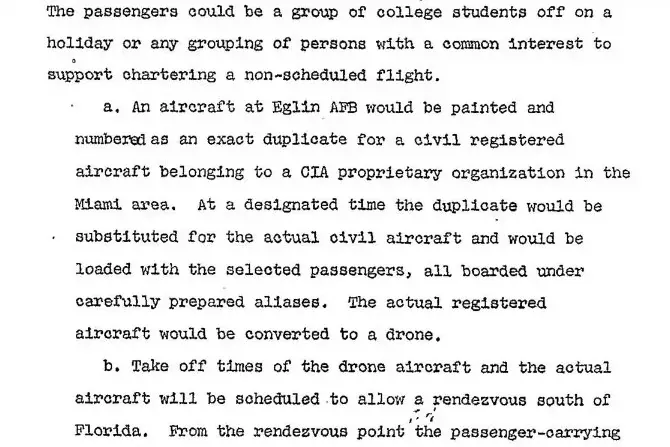
It is possible to create an incident which will demonstrate convincingly that a Cuban aircraft has attacked and shot down a chartered civil airliner enroute from the United States to Jamaica, Guatemala, Panama or Venezuela. The destination would be chosen only to cause the flight plan route to cross Cuba. The passengers could be a group of college students off on a holiday or any grouping of persons with a common interest to support chartering a non-scheduled flight.
a. An aircraft at Eglin AFB would be painted and numbered as an exact duplicate for a civil registered aircraft belonging to a CIA proprietary organization in the Miami area. At a designated time the duplicate would be substituted for the actual civil aircraft and would be loaded with the selected passengers, all boarded under carefully prepared aliases. The actual registered aircraft would be converted to a drone.
b. Take off times of the drone aircraft and the actual aircraft will be scheduled to allow a rendezvous south of Florida. From the rendezvous point the passenger-carrying aircraft will descend to minimum altitude and go directly into an auxiliary field at Eglin AFB where arrangements will have been made to evacuate the passengers and return the aircraft to its original status. The drone aircraft meanwhile will continue to fly the filed flight plan. When over Cuba the drone will being transmitting on the international distress frequency a “MAY DAY” message stating he is under attack by Cuban MIG aircraft. The transmission will be interrupted by destruction of the aircraft which will be triggered by radio signal. This will allow ICAO radio stations in the Western Hemisphere to tell the US what has happened to the aircraft instead of the US trying to “sell” the incident.
It Is possible to create an incident which will make it appear that Communist Cuban MIGs have destroyed a USAF aircraft over international waters in an unprovoked attack.
a. Approximately 4 or 5 F-101 aircraft will be dispatched in trail from Homestead AFB, Florida, to the vicinity of Cuba. Their mission will be to reverse course and simulate fakir aircraft for an air defense exercise in southern Florida. These aircraft would conduct variations of these flights at frequent Intervals. Crews would be briefed to remain at least 12 miles off the Cuban coast; however, they would be required to carry live ammunition in the event that hostile actions were taken by the Cuban MIGs.
b. On one such flight, a pre-briefed pilot would fly tail-end Charley at considerable interval between aircraft. While near the Cuban Island this pilot would broadcast that he had been jumped by MIGs and was going down. No other calls would be made. The pilot would then fly directly west at extremely low altitude and land at a secure base, an Eglin auxiliary. The aircraft would be met by the proper people, quickly stored and given a new tail number. The pilot who had performed the mission under an alias, would resume his proper identity and return to his normal place of business. The pilot and aircraft would then have disappeared.
c. At precisely the same time that the aircraft was presumably shot down a submarine or small surface craft would disburse F-101 parts, parachute, etc., at approximately 15 to 20 miles off the Cuban coast and depart. The pilots returning to Homestead would have a true story as far as they knew. Search ships and aircraft could be dispatched and parts of aircraft found.
…
ENCLOSURE B
FACTS BEARING ON THE PROBLEM
The Joint Chiefs of Staff have previously stated that US unilateral military intervention in Cuba can be undertaken in the event that the Cuban regime commits hostile acts against US forces or property which would serve as an incident upon which to base overt intervention.
The need for positive action in the event that current covert efforts to foster an internal Cuban rebellion are unsuccessful was indicated by the Joint Chief’s of Staff on 7 March 1962, as follows:
”… determination that a credible internal revolt is impossible of attainment during the next 9-10 months will require a decision by the United States to develop a Cuban “provocation” as justification for positive US military action.”
It is understood that the Department of State also is preparing suggested courses of action to develop justification for US military intervention in Cuba.
One hopes your reaction at this point is “Fuck me!”.
Now, OK, the plans were never acted upon. Kennedy didn’t want to use military force anyway, thinking the US military could find itself overstretched. Kennedy removed Lemnitzer as Chairman of the Joint Chiefs of Staff, many are keen to point out. What they often fail to mention is that straight away he became Commander in Chief of US European Command and, two months later, NATO’s Supreme Allied Commander Europe! The main man behind the plan you’ve just read - for the USA to covertly carry out false-flag terrorist attacks - became, months later, Supreme Allied Commander of NATO.
And I hope you didn’t miss the part near the end that talks of “The need for positive action in the event that current covert efforts to foster an internal Cuban rebellion are unsuccessful”. So this is all on top of all the other skulduggery.
Body of Secrets by James Bamford, 2001
Wikipedia:
Physical documentation on Operation Northwoods became declassified through the John F. Kennedy Assassination Records Collection Act of 1992. This act declassified a total of four million documents, including Operation Northwoods, and was made available through the National Archives in College Park, Maryland. However, public knowledge of Operation Northwoods did not come until [April] 2001 with the release of a book by the author James Bamford titled Body of Secrets.
Extract from the book
From Body of Secrets by James Bamford - Doubleday, 2001, p.82 and following
… In [Joint Chief’s chair] Lemnitzer’s view, the country would be far better off if the generals could take over.
For those military officers who were sitting on the fence, the Kennedy administration’s botched Bay of Pigs invasion was the last straw. “The Bay of Pigs fiasco broke the dike,” said one report at the time. “President Kennedy was pilloried by the super patriots as a ‘no-win’ chief … The Far Right became a fount of proposals born of frustration and put forward in the name of anti-Communism… Active-duty commanders played host to anti-Communist seminars on their bases and attended or addressed Right-wing meetings elsewhere.”
Although no one in Congress could have known it at the time, Lemnitzer and the Joint Chiefs had quietly slipped over the edge.
According to secret and long-hidden documents obtained for Body of Secrets, the Joint Chiefs of Staff drew up and approved plans for what may be the most corrupt plan ever created by the U.S. government. In the name of antiCommunism, they proposed launching a secret and bloody war of terrorism against their own country in order to trick the American public into supporting an ill-conceived war they intended to launch against Cuba.
Code named Operation Northwoods, the plan, which had the written approval of the Chairman and every member of the Joint Chiefs of Staff, called for innocent people to be shot on American streets; for boats carrying refugees fleeing Cuba to be sunk on the high seas; for a wave of violent terrorism to be launched in Washington, D.C., Miami, and elsewhere. People would be framed for bombings they did not commit; planes would be hijacked. Using phony evidence, all of it would be blamed on Castro, thus giving Lemnitzer and his cabal the excuse, as well as the public and international backing, they needed to launch their war.
The idea may actually have originated with President Eisenhower in the last days of his administration. With the Cold War hotter than ever and the recent U-2 scandal fresh in the public’s memory, the old general wanted to go out with a win. He wanted desperately to invade Cuba in the weeks leading up to Kennedy’s inauguration; indeed, on January 3 he told Lemnitzer and other aides in his Cabinet Room that he would move against Castro before the inauguration if only the Cubans gave him a really good excuse. Then, with time growing short, Eisenhower floated an idea. If Castro failed to provide that excuse, perhaps, he said, the United States “could think of manufacturing something that would be generally acceptable.” What he was suggesting was a pretext a bombing, an attack, an act of sabotage carried out secretly against the United States by the United States. Its purpose would be to justify the launching of a war. It was a dangerous suggestion by a desperate president.
Although no such war took place, the idea was not lost on General Lemnitzer But he and his colleagues were frustrated by Kennedy’s failure to authorize their plan, and angry that Castro had not provided an excuse to invade.
The final straw may have come during a White House meeting on February 26, 1962. Concerned that General Lansdale’s various covert action plans under Operation Mongoose were simply becoming more outrageous and going nowhere, Robert Kennedy told him to drop all anti-Castro efforts. Instead, Lansdale was ordered to concentrate for the next three months strictly on gathering intelligence about Cuba. It was a humiliating defeat for Lansdale, a man more accustomed to praise than to scorn.
As the Kennedy brothers appeared to suddenly “go soft” on Castro, Lemnitzer could see his opportunity to invade Cuba quickly slipping away. The attempts to provoke the Cuban public to revolt seemed dead and Castro, unfortunately, appeared to have no inclination to launch any attacks against Americans or their property Lemnitzer and the other Chiefs knew there was only one option left that would ensure their war. They would have to trick the American public and world opinion into hating Cuba so much that they would not only go along, but would insist that he and his generals launch their war against Castro. “World opinion, and the United Nations forum,” said a secret JCS document, “should be favorably affected by developing the international image of the Cuban government as rash and irresponsible, and as an alarming and unpredictable threat to the peace of the Western Hemisphere.”
Operation Northwoods called for a war in which many patriotic Americans and innocent Cubans would die senseless deaths, all to satisfy the egos of twisted generals back in Washington, safe in their taxpayer financed homes and limousines.
One idea seriously considered involved the launch of John Glenn, the first American to orbit the earth. On February 20,1962, Glenn was to lift off from Cape Canaveral, Florida, on his historic journey. The flight was to carry the banner of America’s virtues of truth, freedom, and democracy into orbit high over the planet. But Lemnitzer and his Chiefs had a different idea. They proposed to Lansdale that, should the rocket explode and kill Glenn, “the objective is to provide irrevocable proof that … the fault lies with the Communists et al Cuba [sic.]”
This would be accomplished, Lemnitzer continued, “by manufacturing various pieces of evidence which would prove electronic interference on the part of the Cubans.” Thus, as NASA prepared to send the first American into space, the Joint Chiefs of Staff were preparing to use John Glenn’s possible death as a pretext to launch a war.
Glenn lifted into history without mishap, leaving Lemnitzer and the Chiefs to begin devising new plots which they suggested be carried out “within the time frame of the next few months.”
Among the actions recommended was “a series of well coordinated incidents to take place in and around” the U.S. Navy base at Guantanamo Bay, Cuba. This included dressing “friendly” Cubans in Cuban military uniforms and then have them “start riots near the main gate of the base. Others would pretend to be saboteurs inside the base. Ammunition would be blown up, fires started, aircraft sabotaged, mortars fired at the base with damage to installations.”
The suggested operations grew progressively more outrageous. Another called for an action similar to the infamous incident in February 1898 when an explosion aboard the battleship Maine in Havana harbor killed 266 U.S. sailors. Although the exact cause of the explosion remained undetermined, it sparked the Spanish-American War with Cuba. Incited by the deadly blast, more than one million men volunteered for duty. Lemnitzer and his generals came up with a similar plan. “We could blow up a U.S. ship in Guantanamo Bay and blame Cuba,” they proposed; “casualty lists in U.S. newspapers would cause a helpful wave of national indignation.”
There seemed no limit to their fanaticism: “We could develop a Communist Cuban terror campaign in the Miami area, in other Florida cities and even in Washington,” they wrote. “The terror campaign could be pointed at Cuban refugees seeking haven in the United States.
We could sink a boatload of Cubans en route to Florida (real or simulated)… . We could foster attempts on lives of Cuban refugees in the United States even to the extent of wounding in instances to be widely publicized.”
Bombings were proposed, false arrests, hijackings:
-
“Exploding a few plastic bombs in carefully chosen spots, the arrest of Cuban agents and the release of prepared documents substantiating Cuban involvement also would be helpful in projecting the idea of an irresponsible government.”
-
“Advantage can be taken of the sensitivity of the Dominican [Republic] Air Force to intrusions within their national air space. ‘Cuban’ B-26 or C-46 type aircraft could make cane burning raids at night. Soviet Bloc incendiaries could be found. This could be coupled with ‘Cuban’ messages to the Communist underground in the Dominican Republic and ‘Cuban’ shipments of arms which would be found, or intercepted, on the beach. Use of MiG type aircraft by U.S. pilots could provide additional provocation.”
-
“Hijacking attempts against civil air and surface craft could appear to continue as harassing measures condoned by the Government of Cuba.”
Among the most elaborate schemes was to “create an incident which will demonstrate convincingly that a Cuban aircraft has attacked and shot down a chartered civil airliner en route from the United States to Jamaica, Guatemala, Panama or Venezuela. The destination would be chosen only to cause the flight plan route to cross Cuba. The passengers could be a group of college students off on a holiday or any grouping of persons with a common interest to support chartering a non-scheduled flight.”
Lemnitzer and the Joint Chiefs worked out a complex deception:
An aircraft at Elgin AFB would be painted and numbered as an exact duplicate for a civil registered aircraft belonging to a CJA proprietary organization in the Miami area. At a designated time the duplicate would be substituted for the actual civil aircraft and would be loaded with the selected passengers, all boarded under carefully prepared aliases. The actual registered aircraft would be converted to a drone [a remotely controlled unmanned aircraft]. Take off times of the drone aircraft and the actual aircraft will be scheduled to allow a rendezvous south of Florida.
From the rendezvous point the passenger-carrying aircraft will descend to minimum altitude and go directly into an auxiliary field at Elgin AFB where arrangements will have been made to evacuate the passengers and return the aircraft to its original status. The drone aircraft meanwhile will continue to fly the filed flight plan. When over Cuba the drone will be transmitting on the international distress frequency a “May Day” message stating he is under attack by Cuban MiG aircraft. The transmission will be interrupted by destruction of the aircraft, which will be triggered by radio signal. This will allow ICAO [International Civil Aviation Organization radio stations in the Western Hemisphere to tell the U.S. what has happened to the aircraft instead of the U.S. trying to “sell” the incident.
Finally, there was a plan to “make it appear that Communist Cuban MiGs have destroyed a USAF aircraft over international waters in an unprovoked attack.” It was a particularly believable operation given the decade of shoot downs that had just taken place.
In the final sentence of his letter to Secretary McNamara recommending the operations, Lemnitzer made a grab for even more power asking that the Joint Chiefs be placed in charge of carrying out Operation Northwoods and the invasion. “It is recommended,” he wrote, “that this responsibility for both oven and covert military operations be assigned to the Joint Chiefs of Staff.”
At 2:30 on the afternoon of Tuesday, March 13, 1962, Lemnitzer went over last-minute details of Operation Northwoods with his covert action chief, Brigadier General William H. Craig, and signed the document. He then went to a “special meeting” in McNamara’s office. An hour later he met with Kennedy’s military representative, General Maxwell Taylor. What happened during those meetings is unknown. But three days later, President Kennedy told Lemnitzer that there was virtually no possibility that the U.S. would ever use overt military force in Cuba.
Undeterred, Lemnitzer and the Chiefs persisted, virtually to the point of demanding that they be given authority to invade and take over Cuba. About a month after submitting Operation Northwoods, they met the “tank,” as the JCS conference room was called, and agreed on the wording of a tough memorandum to McNamara. “The Joint Chiefs of Staff believe that the Cuban problem must be solved in the near future,” they wrote. “Further, they see no prospect of early success in overthrowing the present communist regime either as a result of internal uprising or external political, economic or psychological pressures. Accordingly they believe that military intervention by the United States will be required to overthrow the present communist regime.”
Lemnitzer was virtually rabid in his hatred of Communism in general and Castro in particular “The Joint Chiefs of Staff believe that the United States can undertake military intervention in Cuba without risk of general war” he continued. “They also believe that the intervention can be accomplished rapidly enough to minimize communist opportunities for solicitation of UN action.” However; what Lemnitzer was suggesting was not freeing the Cuban people, who were largely in support of Castro, but imprisoning them in a U.S. military-controlled police state. “Forces would assure rapid essential military control of Cuba,” he wrote. “Continued police action would be required.”
Concluding, Lemnitzer did not mince words: “[T]he Joint Chiefs of Staff recommend that a national policy of early military intervention in Cuba be adopted by the United States. They also recommend that such intervention be undertaken as soon as possible and preferably before the release of National Guard and Reserve forces presently on active duty.”
By then McNamara had virtually no confidence in his military chief and was rejecting nearly every proposal the general sent to him. The rejections became so routine, said one of Lemnitzer’s former staff officers, that the staffer told the general that the situation was putting the military in an “embarrassing rut.” But Lemnitzer replied, “I am the senior military officer—it’s my job to state what I believe and it’s his [McNamara’s] job to approve or disapprove.” “McNamara’s arrogance was astonishing,” said Lemnitzer’s aide, who knew nothing of Operation Northwoods. “He gave General Lemnitzer very short shrift and treated him like a schoolboy. The general almost stood at attention when he came into the room. Everything was ‘Yes, sir’ and ‘No, sir.’”
Within months, Lemnitzer was denied a second term as JCS chairman and transferred to Europe as chief of NATO. Years later President Gerald Ford appointed Lemnitzer, a darling of the Republican right, to the President’s Foreign Intelligence Advisory Board. Lemnitzer’s Cuba chief, Brigadier General Craig, was also transferred. Promoted to major general, he spent three years as chief of the Army Security Agency, NSA’s military arm.
Because of the secrecy and illegality of Operation Northwoods, all details remained hidden for forty years. Lemnitzer may have thought that all copies of the relevant documents had been destroyed; he was not one to leave compromising material lying around. Following the Bay of Pigs debacle, for example, he ordered Brigadier General David W Gray, Craig’s predecessor as chief of the Cuba project within the JCS, to destroy all his notes concerning Joint Chiefs actions and discussions during that period. Gray’s meticulous notes were the only detailed official records of what happened within the JCS during that time. According to Gray, Lemnitzer feared a congressional investigation and therefore wanted any incriminating evidence destroyed.
With the evidence destroyed, Lemnitzer felt free to lie to Congress. When asked, during secret hearings before a Senate committee, if he knew of any Pentagon plans for a direct invasion of Cuba he said he did not. Yet detailed JCS invasion plans had been drawn up even before Kennedy was inaugurated. And additional plans had been developed since. The consummate planner and man of details also became evasive, suddenly encountering great difficulty in recalling key aspects of the operation, as if he had been out of the country during the period. It was a sorry spectacle. Senator Gore called for Lemnitzer to be fired. “We need a shake up of the Joint Chiefs of Staff” he said. “We direly need a new chairman, as well as new members.” No one had any idea of Operation Northwoods.
Because so many documents were destroyed, it is difficult to determine how many senior officials were aware of Operation Northwoods. As has been described, the document was signed and fully approved by Lemnitzer and the rest of the Joint Chiefs and addressed to the Secretary of Defense for his signature. Whether it went beyond McNamara to the president and the attorney general is not known.
Even after Lemnitzer lost his job, the Joint Chiefs kept planning “pretext” operations at least into 1963. Among their proposals was a deliberately create a war between Cuba and any of a number of .n American neighbors. This would give the United States military an excuse to come in on the side of Cuba’s adversary and get rid of “A contrived ‘Cuban’ attack on an OAS [Organization of Americas] member could be set up,” said one proposal, “and the attacked state could be urged to ‘take measures of self-defense and request ice from the U.S. and OAS; the U.S. could almost certainly obtain necessary two-thirds support among OAS members for collective action against Cuba.”
Among the nations they suggested that the United States secretly were Jamaica and Trinidad-Tobago. Both were members of the Commonwealth; thus, by secretly attacking them and then blaming Cuba, the United States could lure England into the war Castro. The report noted, “Any of the contrived situations de above are inherently, extremely risky in our democratic system in which security can be maintained, after the fact, with very great difficulty. If the decision should be made to set up a contrived situation it be one in which participation by U.S. personnel is limited only to the most highly trusted covert personnel. This suggests the infeasibility of the use of military units for any aspect of the contrived situation.”
The report even suggested secretly paying someone in the Castro government to attack the United States: “The only area remaining for ration then would be to bribe one of Castro’s subordinate commanders to initiate an attack on [the U.S. naval base at] Guantanamo.” The act suggested—bribing a foreign nation to launch a violent attack American military installation—was treason.
In May 1963, Assistant Secretary of Defense Paul H. Nitze sent a the White House proposing “a possible scenario whereby an attack on a United States reconnaissance aircraft could be exploited toward the end of effecting the removal of the Castro regime.” In the event Cuba attacked a U-2, the plan proposed sending in additional American pilots, this time on dangerous, unnecessary low-level reconnaissance missions with the expectation that they would also be shot down, thus provoking a war “[T]he U.S. could undertake various measures designed to stimulate the Cubans to provoke a new incident,” said the plan. Nitze, however, did not volunteer to be one of the pilots.
One idea involved sending fighters across the island on “harassing reconnaissance” and “show-off” missions “flaunting our freedom of action, hoping to stir the Cuban military to action.” “Thus,” said the plan, “depending above all on whether the Cubans were or could be made to be trigger-happy, the development of the initial downing of a reconnaissance plane could lead at best to the elimination of Castro, perhaps to the removal of Soviet troops and the installation of ground inspection in Cuba, or at the least to our demonstration of firmness on reconnaissance.” About a month later, a low-level flight was made across Cuba, but unfortunately for the Pentagon, instead of bullets it produced only a protest.
Lemnitzer was a dangerous-perhaps even unbalanced-right-wing extremist in an extraordinarily sensitive position during a critical period. But Operation Northwoods also had the support of every single member of the Joint Chiefs of Staff, and even senior Pentagon official Paul Nitze argued in favor of provoking a phony war with Cuba. The fact that the most senior members of all the services and the Pentagon could be so out of touch with reality and the meaning of democracy would be hidden for four decades.
In retrospect, the documents offer new insight into the thinking of the military’s star-studded leadership. Although they never succeeded in launching America into a phony war with Cuba, they may have done so with Vietnam. More than 50,000 Americans and more than 2 million Vietnamese were eventually killed in that war.
It has long been suspected that the 1964 Gulf of Tonkin incident-the spark that led to America’s long war in Vietnam-was largely staged or provoked by U.S. officials in order to build up congressional and public support for American involvement. Over the years, serious questions have been raised about the alleged attack by North Vietnamese patrol boats on two American destroyers in the Gulf But defenders of the Pentagon have always denied such charges, arguing that senior officials would never engage in such deceit.
Now, however, in light of the Operation Northwoods documents, it at deceiving the public and trumping up wars for Americans to fight and die in was standard, approved policy at the highest levels of the Pentagon. In fact, the Gulf of Tonkin seems right out of the Operation Northwoods playbook: “We could blow up a U.S. ship in Guantanamo Bay and blame Cuba … casualty lists in U.S. newspapers cause a helpful wave of indignation.” One need only replace “Guantanamo Bay” with “Tonkin Gulf,” and “Cuba” with “North Vietnam” and the Gulf of Tonkin incident may or may not have been stage-managed, but the senior Pentagon leadership at the time was clearly capable of such deceit.
Bamford prefaces the book with four quotes
“In God we trust, all others we monitor.”
—Intercept operator’s motto
NSA study, Deadly Transmissions, December 1970
“The public has a duty to watch its Government closely and keep it on the right track.”
—Lieutenant General Kenneth A. Minihan, USAF
Director, National Security Agency
NSA Newsletter, June 1997
“The American people have to trust us and in order to trust us they have to know about us.”
—Lieutenant General Michael V. Hayden, USAF
Director, National Security Agency
Address on October 19, 2000
“Behind closed doors, there is no guarantee that the most basic of individual freedoms will be preserved. And as we enter the 21st Century, the great fear we have for our democracy is the enveloping culture of government secrecy and the corresponding distrust of government that follows.”
—Senators Daniel Patrick Moynihan and Rob Wyden
US Senate Report, Secrecy in International and Domestic Policy Making: The Case for More Sunshine, October 2000
Reaction from Cuban government when the “Northwoods"" memo was revealed
Describing the reaction to the disclosure of the “Justification for US MilItary Intervention In Cuba” memo, Wikipedia says:
On 3 August 2001, the National Assembly of People’s Power of Cuba (the main legislative body of the Republic of Cuba) issued a statement referring to Operation Northwoods and Operation Mongoose wherein it condemned such U.S. government plans.
This is that statement:
Statement by the National Assembly of People's Power of the Republic of Cuba
Five Cuban Patriots are political prisoners of the Empire. They have already suffered more than 34 months of unjustified incarceration in a South Florida penitentiary. René González Sehwerert, Ramón Labañino Salazar, Fernando González Llort, Antonio Guerrero Rodríguez and Gerardo Hernández Nordelo have sustained almost three years of constant humiliation, gross and systematic violation of their human rights and long and arbitrary periods of solitary confinement.
They are innocent. They have committed no crime whatsoever.
They are being punished because Cuba’s enemies see in them an outstanding combination of the virtues, dignity and courage compound in the country these enemies are bent on destroying. They are victims of an infamous and enormous injustice that marks the beginning, under the current Administration of Mr. Bush, of a new and even more cruel and shameless stage in the long and dirty war that the United States has been carrying out against the Cuban people and their Revolution.
They were condemned for alleged espionage under completely false charges and unfair pressure applied to the jury. The charges were never proved and during the trial even the prosecution admitted that the defendants had never been in possession of any secrets nor carried out the alleged crime.
In Miami it is impossible to receive a fair ruling in any case related to Cuba. There, professed terrorists walk the streets and boast of their dreadful deeds that they publicly announce and prepare while the authorities do absolutely nothing to prevent or condemn these actions. Lies, hysteria and anti-Cuban hatred, under the sway of a corrupt and fascist lobby group, poison the Miami environment. We have only to remember the kidnapping of Elián González, a six year old child brutally separated from his father and family, shamelessly mistreated and exploited in front of the television cameras and surrounded by armed killers and strident demagogues who challenged the law, insulted and threatened the Federal Government, desecrated the American banner, damaged private property and even threatened to burn down the city.
According to the U.S. authorities, a delicate operation was necessary to rescue the child due to the immense risk posed by the stubborn opposition mounted by heavily armed individuals. Where were the FBI and Florida’s District Attorneys? What was their reaction to the shameful impudence witnessed by the whole world and repudiated by humanity and by all the American people? The basic rights of a child, including his physical and psychological integrity, were flagrantly offended and the American legal system, decency and honor defamed but nobody was ever tried or indicted, or even arrested.
Those individuals, recruited and trained by the CIA to act against Cuba, paid for decades with federal budget funds, have lived in permanent and intimate connivance with the extreme right-wing and interfered with domestic life in America paying lip service to the interests of the American people. They have been linked to the most outrageous episodes there such as the assassination of President Kennedy, the Watergate scandal, the murder of Orlando Letelier and Ronni Moffitt, the secret supply of weapons to the Nicaraguan contras and the related drug trafficking, the smuggling of people and of illegal drugs, the kidnapping of Elián González and the fraudulent denial of the rights of tens of thousands of African American voters in the November 2000 elections in Florida.
Cuba has always told the full and honest truth: we have never made any attempts against the national security of the United States. However, we do proclaim our irreversible right and sacred obligation to defend ourselves from the terrorist and criminal actions that the annexionist Mafiosi plan, arrange, announce and launch with impunity against Cuba from U.S. territory. To expose these actions is a noble, heroic and worthy mission that saves Cuban and American lives and is in keeping with the vital interests of both our peoples.
Throughout its history, the Cuban Revolution has been the target of a systematic policy of aggression, a real war, in which terrorism, sabotage and murder have not been missing. This war is now over 42 years old. The aggressor has been, and it continues to be, the government of the United States. Nobody should ignore this fact that can be easily confirmed through official American documents, most of which were kept secret until recently. A large part of their content remains undisclosed, but even so the total responsibility of that Government for the unceasing aggression shows clearly beyond any doubt. Following are some data that are explicitly acknowledged and described in those documents by their protagonists, thus becoming irrefutable truths:
- Upon direct instructions from President Eisenhower, the Central Intelligence Agency has actively intervened in Cuban affairs since 1958, before the triumph of the Revolutionary movement, which it attempted to frustrate. It supported Batista’s followers before and after their defeat and recruited agents and collaborators amongst them, who would later become the core of the counter-revolutionary “opposition” thus fabricated. This can be found in a book published in 1991 by the State Department containing previously undisclosed communications covering the years of 1958 to 1960.
- From 1959 the United States has attempted to bring down the Cuban government through a program of covert actions including terrorism, sabotage and the Bay of Pigs military invasion. A detailed description appears in the report of the then CIA Inspector General, entered in October 1961, and made public for the first time in February 1998.
- After the Bay of Pigs failure, the United States continued to nurture crime and terrorism through the so-called “Operation Mongoose” and it drew up plans which included even direct military invasion as recorded in official texts for the period 1961-1963 of the volume published by the State Department in 1997.
- Also in 1997, more than 1500 pages of previously classified Pentagon documents were opened showing a policy of outrageous contempt. One of these, dated the March 13, 1962, carries the significant heading “Pretext to justify U.S. military intervention in Cuba”. It is odd that incidents involving supposedly civil airplanes similar to that which the Miami terrorists provoked years later were among the pretexts included.
- In 1975, the U.S. Senate Special Committee headed by Senator Frank Church published its report on plans to assassinate foreign leaders. A large part of this referred to the numerous attempts over many years to assassinate President Fidel Castro, directed by the CIA with the participation of the Miami terrorists and even using the Mafia.
- On June 23, 1999, the U.S. Attorney General’s Office issued a decision published by the UN Security Council on the May 8, 1992 declaring well- known terrorist Orlando Bosch a persona non grata on American territory based on extensive evidence of his past and present crimes including his role as one of the masterminds behind the sabotage of a Cuban civil plane in October 1976. Despite this, President George H. Bush allowed Bosch to go free. Mr. Bosch is currently in Miami with total impunity.
The above are only a few examples. Emboldened by the long-standing support of authorities that enlisted, trained and directed them to kill; who have supported and protected them; who have participated in and tolerated their outrages, these terrorists have described their actions in reports, statements and public interviews and have been given extensive coverage by the press, radio and television in Miami. Those whose responsibility should be to stop their crimes have ever reprimanded not one of them.
In November 1996, for example, Channel 23 of Miami television carried a live interview with Orlando Bosch and Luis Posada Carriles (a CIA veteran, one of the masterminds of the 1976 sabotage of the Cuban plane, a secret official of the White House responsible for the illegal supply of weapons to the Nicaraguan contra) who, aware that nobody would dare touch them, boasted of their criminal history and stressed that their terrorist campaign against Cuba would go on undeterred.
On the July 12 and 13, 1998, The New York Times ran on its front page an interview with Posada Carriles, the most notorious terrorist of this hemisphere, in which he claimed responsibility for various bomb explosions in Havana in 1997, one of which caused the death of a young Italian tourist. He went on to explain the abundant funding received for his actions from the so-called Cuban American National Foundation, he announced new terrorist attacks against Cuba and boasted of his many visits to the United States as well as his close links to his former colleagues in the CIA. Days later, in another interview with a Florida television channel, he repeated his shameless declarations. Still today in Miami, funds are raised and public rallies called in support of this detestable murderer.
Cuba’s right to defend itself against anyone attempting to destroy and annihilate its people is unquestionable. Our defense has been particularly complex and difficult due to the close alliances between the terrorists groups and agents and officials of the U.S. Government, who have conspired together for many years; also because the U.S. authorities have, at best, been indolent and tolerant with them.
Nevertheless, Cuba has done everything possible to warn Washington, through private channels as well as publicly, of the danger of these actions, even delivering information obtained through the heroic sacrifice of men such as those who are now unjustifiably imprisoned there. We, thus, alerted to the presence of armed individuals around the house where Elián was being held and of plans to oppose his liberation. Once this objective was attained, those involved admitted the truth and accuracy of the information Cuba supplied.
Many contacts have been made in New York, Washington and Havana, in which we have supplied information to the FBI and other U.S. government agencies which would have been useful to act against the terrorists had there been the necessary will to do so. After numerous exchanges, including messages at the top levels, an official delegation came to Havana on June 16 –17, 1998, including two important FBI chiefs to whom extensive information was supplied and operative materiel, such as incriminating tapes and recordings of the actions of 40 criminals. They promised a response within two weeks, but it never came. Neither was there any FBI reaction to the abundant and irrefutable evidence received. On the contrary, three months later, the FBI arrested our heroic comrades, hurled treacherous slander against them and instigated a pseudo-legal process aimed at exalting some ringleaders of the terrorist groups whom, to top it all, they called as witnesses.
The most contemptible, indecent and absurd accusation against our honorable and heroic comrades was that of “conspiracy to murder”, suspiciously raised after they had spent more than eight months in solitary confinement, while facing the ridiculous and senseless initial charges which were as baseless as this. Naturally, the corrupt authorities in Miami could not present any evidence to support this infamy, but they shamefully manipulated the incident of February 24, 1996, concealed information in their possession, completely ignored the background, introduced faked evidence and grossly distorted reality.
But, the truth will prevail. The truth will never be defeated by their clumsy and deceitful maneuvers.
If one iota of justice existed in America, others would be sitting in the dock to receive the most severe and unappealable sentence.
The U.S. authorities are perfectly aware of everything related to this incident. They know every detail and are wholly and absolutely responsible for what happened that day.
Since the triumph of the Revolution and from U.S. territory, the CIA has used small planes manned by its agents for sabotage, dropping weapons, to spread chemicals and bacteriological substances and carry out espionage and provocation over the countryside and cities of Cuba. In the previously cited documents there is plenty of information to this effect including the background of the terrorist group involved in the provocation of February 24, 1996.
There is a wealth of information about this group that can be found in these and other official documents, and in the U.S. press. This can be summed up as follows:
-
They use planes previously employed in the wars in Vietnam and El Salvador given to them by the U.S. Air Force from which the “USAF” signs have not been completely erased.
-
Officials from the U.S. military aviation instructed their crews.
-
They have repeatedly violated Cuban airspace and national territory, and they have even flown over the city of Havana.
-
Journalists and photographers, who then widely reported their provocations in the Miami press and media, have joined them.
-
On occasions, they were joined by the then Head of the Cuban Bureau at the State Department, who is presently nothing less than the Executive Vice Chairman of the terrorist monstrosity known as the Cuban American National Foundation.
-
From the spring of 1995 their actions grew ever more provocative and challenging, leading to systematic violations of international and American regulations.
-
Cuba warned the top leadership in Washington, both privately and publicly, of the grave dangers involved in these actions, and of its decision to prevent any further violation of our sovereign territory.
-
Cuba received private assurances from the United States Administration top leadership that such provocations would not take place again.
-
Simultaneously, the Federal Aviation Agency of the United States initiated administrative proceedings against that group for their repeated transgressions and to that end it requested and received Cuba’s cooperation which it appreciated and it so expressed in writing.
-
As to the incident of February 24, 1996, the information officially provided by the United States to the International Civil Aviation Organization (ICAO) and the evidence later presented under oath to the administrative proceedings referred to in the previous paragraph, states what follows:
-
Since at least February 17th, the authorities of that country knew that a provocation was being planned for the 24th. On the 24th, the State Department communicated with the control tower of Opalocka airport on various occasions before the take off of the planes, to verify their departure.
-
The planes, from take off and during the time they were over United States territory and air control zone (1 hour, 45 minutes), completely ignored the flight plan that had been approved by the air traffic controllers.
-
At no time were they ordered to land or call off their flight despite the fact that they had abandoned their approved plan and were following an unauthorized route, and despite previous violations for which they had already been processed. American radars recorded that the planes flew in a straight line towards the Cuban capital, that they crossed the limit of our airspace and proceeded in the same direction.
-
The authorities in Washington were the only ones who knew that this provocation was going to take place; they knew when, how, who and with what means it would be carried out. They did nothing, although they could and should have done something to prevent it or avoid it. Neither did they warn Cuba of what they knew was about to occur.
What was the conspiracy and who were involved?
The only ones responsible are those same authorities and the terrorist bosses who are allowed to act wantonly. It is them and no one else who are to be held accountable for the outcome of the incident.
The position adopted by that government was absolutely indescribable. They used the incident to justify the signing of the Helms-Burton Act, they stripped Cuba of funds illegally held in escrow in U.S. banks and handed them over to the annexionist Mafiosi and now, taking cowardice and vileness to their extreme, they want to punish five patriots who are totally innocent and are in no way responsible for that incident.
Nobody but those authorities and the terrorists they nurtured and used against Cuba for four decades, has conspired to kill, attempted to murder and murdered, taking a high toll in human lives and causing significant material damage to our country.
The terribly arbitrary action against our fellow countrymen has nothing to do with justice and law. It is the most repugnant expression of a new stage in the aggression unleashed against Cuba by the extreme right now in power and the annexionist Mafiosi in its service, whose consequences are already affecting many Americans and Cuban Americans.
The clearest evidence that the case against our five compatriots is part of a plan deliberately conceived to support the terrorist groups and to spread terror amongst their opponents, was openly offered on July 10 by the Chief of the FBI, in charge of this operation. On this occasion, Mr. Héctor Pesquera announced that “there will be more arrests related to this case”, he assured that he was “constantly informed of all those involved” and promised he would “tirelessly pursue them”. A few days later, as if in echo, the same bravado was repeated by the spokeswoman of the annexionist CANF. What else is necessary to understand that we are dealing with an exclusively political process whose aim is to persecute all those who repudiate the criminal practices of the terrorist Mafia?
But these are more than merely shrill boasts. On July 13, the President of the United States made an insolent declaration where in addition to proclaiming new tactics to reinforce the blockade and aggression against Cuba, he announced specific measures and concrete threats against American citizens and residents of Cuban origin. The occupant of the White House explained that he had given instructions to strengthen and expand the mechanisms of the blockade specifically to prevent unauthorized trips to Cuba, and to strictly control the visits and remittances allowed, as well as to increase the funds and material support to the counterrevolutionary grouplets which operate against Cuba.
Bush’s declarations are not simply rhetoric. Hundreds of Americans have already received official court summons, and many have been fined thousands of dollars. Travelers in the Miami airport receive clear written warning of the severe punishments –up to 10 years in prison and a 250 000 US dollars fine– for those who disobey the rigid rules of the blockade which the current President intends to enforce at all costs.
The number of Americans and Cuban Americans, who, threatened with possible criminal action are required to fill in thorough questionnaires reminiscent of the worst days of McCarthyism, continues to increase.
To ensure the implementation of his anti-Cuban policies, the leader of the current Administration has nominated to key positions there various individuals with notorious records in the war against Cuba.
The nominee for the highest position in the Latin American Office of the State Department has naturally created alarm inside as well as outside the United States.
But there are other appointments that have crept silently forward, almost unnoticed. One of these is Mauricio Tamargo for president of the Federal Claims Commission; another is Adolfo Franco who, it is announced, would be mostly responsible for Latin America within the so-called International Development Agency (IDA). Both are on the payroll of Cuba’s worst enemies in the U.S. Congress in Washington.
The choice of Mr. Tamargo is clear proof of the present government support for the Helms-Burton Act, the essence of which, as is known, is the illusory aspiration to return property to Batista’s followers and the old ruling class, robbing Cubans of their land, homes, schools, factories, hospitals and everything that belongs to the people. To choose one of their representatives to front the federal entity that with absolute powers within the American structure is responsible for property claims, is tantamount to putting the issue completely in the hands of that Mafia.
The nomination of Mr. Franco confirms the stated purpose of intensifying subversion against Cuba, increasing funds dedicated to the creation, financing and direction of grouplets of traitors in the service of the United States, part of which funds is distributed by the IDA. Over the last 42 years Washington has dedicated more resources to this end than those assigned to the alleged development aid for our continent. To place a representative of the annexionist Mafiosi in this position is a clear expression of an anti-Cuban policy and a strong message to those that in Latin America still naively believe in the chimerical aid of the Empire.
The ever more hostile and aggressive course towards Cuba pursued by the current Bush Administration constitutes an unforgivable crime against our people which cannot be seen separately from the irresponsible and adventurous policy that endangers peace and life on an international scale but it also seriously undermines the rights of the American people, including those Cuban immigrants and their descendents and all the other Florida residents. These people hope to live free from corruption, illegality and the violence of criminals who enjoy official complicity and tolerance and benefit from the budgetary resources which could better be used for the well-being and development of American families.
It is necessary to put an end to the official connivance with terrorists and halt the McCarthyist campaign, the persecution and threats against American citizens who oppose the blockade and against immigrants and residents in Florida who suffer the outrages of terrorism. Right away, as a first indispensable step, it is necessary to demand the liberation of our five innocent compatriots incarcerated in a Miami jail.
René González Sehwerert, Ramón Labañino Salazar, Fernando González Llort, Antonio Guerrero Rodríguez and Gerardo Hernández Nordelo, political prisoners of the Empire, exemplary patriots, selfless and admirable heroes who have caused no harm to anyone but who have sacrificed their lives to save their people, must be set free.
Cuba is a free, independent and sovereign nation that has an inalienable right to live in peace and be respected like every other nation. It is Cuba’s right, obligation and necessity to defend itself and it will continue to do so.
The people of Cuba and the United States can and should live in peace. The struggle for truth and justice will allow this to happen.
National Assembly of People’s Power
Havana, August 3, 2001
“Year of the Victorious Revolution in the New Millenium”
SUMMARY OF THE MAIN TERRORIST ACTIONS AGAINST CUBA
(1990-2000)
From 1959 on, counterrevolutionary groups created and run by the US Central Intelligence Agency (CIA) have carried out numerous terrorist activities which have cost our country valuable lives and vast amounts of resources.
Encouraged by the fall of the socialist camp at the beginning of the 90s, these groups intensified their violent actions against the Cuban people and its leaders from US territory and from other bases of operations in Central America.
Below are listed some of the most important of these actions, which are of public domain.
July 17, 1990. Following lobbying by Florida Republican Congresspersons, Ileana Ross and Connie Mack, U.S. President George H. Bush released from jail well-known terrorist Orlando Bosch, the man chiefly responsible for the October 1976 blasting of a Cuban civil airplane in mid-flight, killing all 73 on board.
October 14, 1990. Two armed terrorists sneaked into Santa Cruz del Norte as part of an action concocted in Miami. They had orders to carry out violent actions. Their weapons and false documents supplied in Miami were confiscated. They also carried literature urging people to join what they called “The Cuban Liberation Army” headed by Higinio Díaz Anne who had given them money and propaganda before they set out.
May 15,1991. José Basulto, an ex-Bay of Pigs mercenary and well-known terrorist and CIA agent founded the so-called “Brothers to the Rescue”. He asked U.S. President George H. Bush for three U.S. Air Force type 0-2 planes, the military version of the Cessna which had been used in the war in El Salvador. Congresswoman Ileana Ross started a public campaign and lobbied until the three planes were obtained. A photo of the planes received by this counterrevolutionary group appeared in the press for the first time with a July 19 article by the publisher of the Miami Herald, who flew with Brothers to the Rescue. The letters USAF (United States Air Force) are clearly visible on the planes.
September 17,1991. Two counterrevolutionaries from Miami infiltrated into Cuba. Their mission was to sabotage tourist shops to spread terror among foreign tourists. Their weapons and a radio transmitter were confiscated.
December 29, 1991. Three terrorists from the so-called Commandos L group in Miami entered Cuba illegally. Their weapons and other war materiel were confiscated. These three had received training with 50 or 60 other men in a camp on 168 Street in Miami.
May 8 1992. Cuba files a complaint with the United Nations about terrorist activities organized against its territory. At Cuba’s request, a June 23, 1989 decision of the U.S. Department of Justice is circulated as an official Security Council document. The decision states that Orlando Bosch is banned from entering the U.S. territory because there is substantial proof concerning his past and present terrorist activities, including the 1976 blasting off of a Cuban civil aviation plane in mid-flight.
Today this individual freely walks the streets of Miami after George H. Bush granted him a presidential pardon.
July 4, 1992. A group of terrorists set out from the United States to attack economic targets along the Havana coastline. Once detected by Cuban patrol boats, they moved to waters off Varadero, where U.S. coastguards rescued them after their boat had a mechanical failure.
The FBI released them after the confiscation of weapons, maps and videos made during their journey.
July 1992. An operation to infiltrate an U.S. based terrorist into Cuba with the mission to sabotage an economic target in Villa Clara province failed. He was carrying the weapons and explosives needed for the job and had the assistance of Brothers to the Rescue who kept him informed about the position of the U.S. coastguard to make it easier for him to reach Cuban territory.
September 9, 1992. The FBI for illegal possession of firearms and violation of the Law of Neutrality arrests a Cuban born terrorist. He is released without charges.
October 7, 1992. An armed attack against the Varadero Meliá Hotel is perpetrated from a vessel manned by four Miami terrorists who were later arrested and questioned by the FBI, then released.
October 19, 1992. Three Miami based counterrevolutionaries entered Cuba illegally with plenty of weapons and military equipment that were confiscated. At the same time, three other terrorists were arrested in the Bahamas with weapons and explosives apparently destined for Cuba, which were also seized from them. These terrorists had left Miami on October 17.
January 1993. Five terrorists on board a vessel armed with heavy machine guns and other weapons were arrested by the U.S. coastguard as they were heading toward the Cuban coastline. They were soon released.
January 7, 1993. At a press conference in Miami, Tony Bryant, leader of the terrorist group “Commandos L” announced plans to carry out more attacks against targets in Cuba, especially hotels. He said: “from now on we are at war with Cuba” and warned foreign tourists to “stay away from Cuba.”
April 2, 1993. The tanker ship “Mikonos” sailing under the Cypriot flag was fired on 7 miles north of Matanzas from a vessel crewed by Cuban born, U.S. based terrorists.
May 18, 1993. A violation of Cuban airspace by a plane registered to “Brothers to the Rescue” with the number N8447.
May 21, 1993. Nine terrorists arrested by the U.S. Customs Service on board a vessel as they prepared to sail for Cuba to launch attacks on that country. Their weapons and explosives were seized. On August 21, Judge Lawrence King dismissed charges against them.
May 1993. “Brothers to the Rescue” planned to blow up a high-tension pylon near San Nicolás de Bari in Havana province.
October 1993. “Brothers to the Rescue” publicly encouraged attempts on the life of President Fidel Castro and violence against Cuba. It also confirmed its readiness to accept “the risks that come with doing this”. Andrés Nazario Sargén, head of terrorist group Alpha 66, makes an announcement in the United States that his organization has recently carried out five operations against Cuba.
October 18, 1993. A terrorist living in the United States is arrested on his arrival in Cuba. His orders were to carry out acts of violence on Cuban soil.
November 7, 1993. Humberto Pérez, spokesperson for Alpha 66, said in a press conference in Miami that their war against Cuba would soon be extended to any tourist visiting the island: “We consider anyone staying in a Cuban hotel to be an enemy,” he affirmed.
1993. A Cuban citizen visiting the United States is recruited by a terrorist organization to carry out sabotage in Cuba against the tourism and agricultural sectors. He was supplied with some of the materials needed for such actions and was offered the sum of 20,000 US dollars.
March 11, 1994. A terrorist group from Miami fires on the “Guitart Cayo Coco Hotel”.
April 17, 1994. Planes owned by “Brothers to the Rescue” fly at extremely low altitude over Havana and drop smoke bombs. In the following months of 1994 the same group carried out at least seven other similar violations of Cuba’s airspace.
September 4, 1994. Two U.S. based terrorists infiltrated into the area around Caibarién, Villa Clara, with the aim of carrying out sabotage in that province. A number of weapons and large amounts of military equipment were seized.
October 6, 1994. Another armed group fired automatic weapons at the “Guitart Cayo Coco Hotel” from a boat that set out from Florida.
October 15, 1994. A group of armed terrorists coming from the United States landed on the causeway to “Cayo Santa María” near Caibarién, Villa Clara, and murdered comrade Arcelio Rodríguez García.
October 1994. “Brothers to the Rescue” uses one of its planes to train members of a Florida based counterrevolutionary organization to carry out acts of sabotage on the Cienfuegos oil refinery.
In November of that same year, they also planned to make an attempt on the life of President Fidel Castro and other leaders of the Revolution and to smuggle arms and explosives into Cuba.
November 1994. Terrorist Luis Posada Carriles and five of his accomplices smuggled weapons into Cartagena de Indias, Colombia, during the IV Ibero-American Summit of Heads of State and Government in order to make an attempt on the life of President Fidel Castro. However, the security belt keeps him at a distance thus thwarting his aim. Posada Carriles later told The New York Times: “I was standing behind some journalists and I saw Castro’s friend, García Márquez, but I could only see Castro from a long way away.”
November 11, 1994. Four terrorists were arrested in Varadero, Matanzas. After sneaking into Cuba, they were relieved of weapons and munitions.
March 2, 1995. Two terrorists from the United States sneaked into the coast near Puerto Padre, Las Tunas. They were carrying 51 pounds of C – 4 explosives and other munitions.
April 4, 1995. A C – 337 light plane violates Cuban airspace north of Havana between Santa Fé and Guanabo beach.
May 20, 1995. The “Guitart Cayo Coco Hotel” was once again attacked by terrorists manning a fast launch coming from the United States.
July 12, 1995. Three terrorists were arrested in the United States as they were preparing to sneak into Cuba using an act of provocation just off the Cuban coast as cover. Despite confiscation of their weapons and explosives, U.S. authorities released them.
July 13, 1995. Organized by “Brothers to the Rescue” eleven vessels, six light planes and two helicopters coming from the United States enter Cuban territorial waters and airspace. One of the light planes flew over the heart of Havana and dropped propaganda material.
December 16, 1995. Two terrorists were arrested in the United States as they readied to sneak into Cuba through Pinar del Río to carry out subversive actions. Despite confiscation of their weapons and explosive, U.S. authorities released them.
January 9, 1996. Two light planes departing from Opa-locka airport in Florida violated Cuban airspace.
January 12, 1996. A Cuban immigrant living in the United States was arrested while trying to transport explosives from the City of Havana to Pinar del Río.
January 13, 1996. Several “Brothers to the Rescue” planes violated Cuban airspace over the City of Havana. Later, terrorist Basulto said: “They say I was flying over Cuban airspace, something everybody knows and which I have never denied.”
January 23, 1996. U.S. authorities intercepted a vessel in Marathon Key with five armed terrorists on board. It was headed for Cuba. The FBI released the five that same day.
February 11, 1996. After firing on our coastline, a vessel coming from the United States carrying three terrorists was captured by the Cuban a cost guard patrol.
February 24, 1996. “Brothers to the Rescue” launched a new foray. Three light planes violated Cuban airspace over the heart of Havana and two of them were shot down. In the 20 months prior to this incident there had been at least 25 other violations of Cuban airspace.
June 26, 1996. At a session of the International Civil Aviation Organization (ICAO), the Chairman of the Investigating Committee acknowledges that at least one of the “Brothers to the Rescue” planes in Opa-locka airport still has the insignia of the U.S. Air Force on it: “the ‘F’ is a little pale, it looks as if it is beginning to fade, but you can still see it”.
August 21, 1996. An U.S. citizen is arrested in Cuba. He had clandestinely brought military equipment into the country and was planning to carry out terrorist actions on Cuban soil.
September 16, 1996. A person is arrested who was sneaking into Cuba through Punta Alegre, Ciego de Ávila, on a boat carrying weapons and a great deal of military equipment.
21 October 1996. An SS-RR light plane, registration number N3093M owned by the U.S. State Department sprays a substance containing the pest “Thrip Palmi Karny” as it flies over the “Girón” international corridor about 25-30 kilometers south of Varadero.
November 1996. Miami television channel 23 carried a live interview with Luis Posada Carriles and Orlando Bosch where they stressed their intentions of continuing with their terrorist activities against Cuba.
April 12, 1997. An explosive device was detonated in the “Meliá Cohíba” Hotel in the City of Havana.
April 30, 1997. Discovery of an explosive device in the “Meliá Cohíba” Hotel.
July 12, 1997. Bombs blasted in the “Capri” and “National” hotels.
August 4, 1997. Another bomb exploded in the “Meliá Cohíba” Hotel.
August 11, 1997. The Miami press published a statement from the Cuban American National Foundation (CANF) giving unconditional support to the terrorist bomb attacks against civilian and tourist targets in Cuba. The chairman of this organization claimed: “We do not think of these as terrorist actions” and went on to say that any action against Cuba was legitimate.
August 22, 1997. Bomb exploded in the “Sol Palmeras” Hotel in Varadero.
September 4, 1997. Several bombs exploded in the “Tritón”, “Chateau Miramar” and “Copacabana” hotels. The explosion in the latter killed young Italian tourist Fabio Di Celmo. On that same day another bomb exploded at “La Bodeguita del Medio” restaurant.
September 10, 1997. The Cuban Government announced the arrest of Salvadoran national Raúl Cruz León, the person responsible of placing six of the bombs that exploded in various hotels in the Cuban capital, including the one that killed Italian tourist Fabio Di Celmo. Cruz León admitted that he had been paid 4,500 US dollars for each bomb.
October 19, 1997. An explosive device was found in a tourist van.
October 27, 1997. The U.S. Coastguard arrested a vessel West of Puerto Rico. They confiscated 2 high velocity rifles .50 caliber with their tripods, night vision gear, and military uniforms and communications equipment. These sophisticated weapons, strictly military in nature, are designed for long-range attacks on vehicles and aircraft. One of those on the vessel said that his aim was to assassinate President Fidel Castro when he arrived on Margarita Island, Venezuela, on November 7, 1997 to attend the Ibero-American Summit.
U.S. authorities found that the vessel was registered by a Florida company whose chief executive officer, manager, secretary and treasurer is José Antonio Llama, a director of the CANF and a Bay of Pigs mercenary.
One of the guns was registered in the name of José Francisco “Pepe” Hernández, CANF co-chairman. A member of Brigade 2506 had bought the other in 1994.
The four crew members on the vessel were identified as: a well-known CIA agent; the captain of a CIA boat used by Florida infiltration teams sneaking into Cuba; the chairman of a New Jersey counterrevolutionary group and a member of Alpha 66.
Despite their confessions and clear proof of the illegal possession of arms, false testimony and arms smuggling, these terrorists were acquitted by a Federal court of law in December 1999 after a rigged trial.
October 30, 1997. Discovery of an explosive device in a kiosk outside terminal 2 at the “José Martí” International Airport in the City of Havana. Two men originally from El Salvador and three originally from Guatemala would later be arrested for crimes against tourist facilities. They all were linked with terrorist Luis Posada Carriles.
November 16, 1997. Following a two months investigation, a Florida newspaper reported that the series of bomb explosions in Havana were bankrolled and directed by Miami anti-Cuban groups and that Luis Posada Carriles, a fugitive from justice for having blown up a Cuban plane in 1976, was at the heart of the operation.
May 1998. Two terrorists sneaked into Santa Lucía, Pinar del Río. They had set out from the United States with a great deal of weapons and war materiel.
June 16, 1998. After several meetings in which the Cuban Government gave information to the FBI and other U.S. Government agencies about terrorist activities concocted in the United States against Cuba, an official U.S. delegation traveled to Havana including two of FBI top brass, which was given precise details, even films, recordings and other material evidence on the activities of 40 terrorists who operated out of the United States.
July 12, 1998. An article in The New York Times for this date published statements by Cuban American Antonio Jorge Alvarez concerning the fact that the FBI had not investigated information he had volunteered related to an attempt on the life of President Fidel Castro that was being planned for the Ibero-American Summit in Venezuela. Alvarez claimed that the previous year he had provided information that Posada Carriles, and a group working in his factory in Guatemala, were preparing this attempt and the bomb explosions in Havana: “I risked my business and my life and they did nothing,” he said.
July 12 and 13, 1998. In an interview with The New York Times, Luis Posada Carriles admitted to having organized the bomb campaign against Cuban tourist centers. He also acknowledged that the leaders of the CANF had bankrolled his operations and that its chairman Jorge Mas Canosa was personally in charge of overseeing the flow of funds and logistic support to those operations: “Jorge Mas Canosa controlled everything, whenever I needed money he would say that he would give me 5 0000, 10 000, even 15 000 and he did.”
Posada also admitted to having paid Raúl Cruz León for placing the bombs in Havana hotels. Referring to the Italian tourist killed by one of those bombs, he told the Times: ”… he was sitting in the wrong place at the wrong time.”
In compiling these reports, the Times used CIA and FBI files, testimony from more than 100 people and more than 13 hours of recorded interviews with Posada Carriles and even documents signed by him.
July 23, 1998. The Miami press published an article entitled “In the United States anti-Castro plots rarely lead to jail”. The article mentions several cases, such as the 1990 acquittal of 6 terrorists who took guns and other weapons to Nicaragua for an attempt on the life of the Cuban President. It also mentions the Rodolfo Frómeta and Fausto Marimóm’s 1994 acquittals of charges of planning to use Stinger antiaircraft missiles and other weapons in terrorist attacks. The article quotes statements too from well-known terrorist Tony Bryant who said that in 1989 the FBI stopped him in a boat loaded with weapons and explosives and they let him go. He added that he had been intercepted in two of his 14 missions against Cuba, but they never did anything to him.
August 2, 1998. Posada Carriles, in an interview for the program Opposing Points of View for CBS news, said that he intended to launch more attacks on Cuban facilities, either inside or outside the island.
August 1998. Even before President Fidel Castro’s announcement that he would attend the Summit of Heads of State and Government of CARIFORUM in the Dominican Republic, several Cuban born terrorists had planned an attempt on his life to be carried out some time between August 20 and 25.
To that end, terrorist Posada Carriles arranged a meeting in the Guatemala City Holiday Inn Hotel one month before the summit to plan how to get weapons and explosives into Santo Domingo.
September 12, 1998. Five Cuban patriots were arrested in Miami who were defending both Cuban and U.S. citizens from the terrorist actions which, with total impunity, are organized, prepared and launched against Cuba from the United States territory.
November 17, 2000. A group of terrorists headed by Posada Carriles was arrested in Panama. They had entered Panama with false documents to make an attempt on the life of President Fidel Castro during the X Ibero American Summit of Heads of State and Government. Their weapons, explosives and a sketch of Castro’s route and public meetings were seized from them. The Cuban American National Foundation is paying for the team of lawyers defending the terrorists.
April 26, 2001. Three terrorists of the Commandos Groups F-45 and Alpha 66 tried to land on the north coast of Villa Clara province and, after firing shots at Cuban coastguard troops who had spotted them, were taken prisoner. Four AKM rifles, one M-3 rifle with a silencer, 3 hand guns, a great deal of materiel, night vision equipment and communications equipment were confiscated to them, all of which they intended to use to carry out sabotage and terrorist actions on Cuban soil.
In addition to the plots listed above, our authorities learned of 16 other plots to assassinate the President of Cuba, 8 plots to try to kill other leaders of the Revolution and 140 other terrorist plots hatched between 1990 and 2001. These were foiled, discouraged or prevented by the work of the Cuban Security and Intelligence Services.