This was posted on Reddit by the photographer, Charles Brooks, in September 2022.
Prints are available, along with other shots from the series, at www.architectureinmusic.com/pages/gallery.
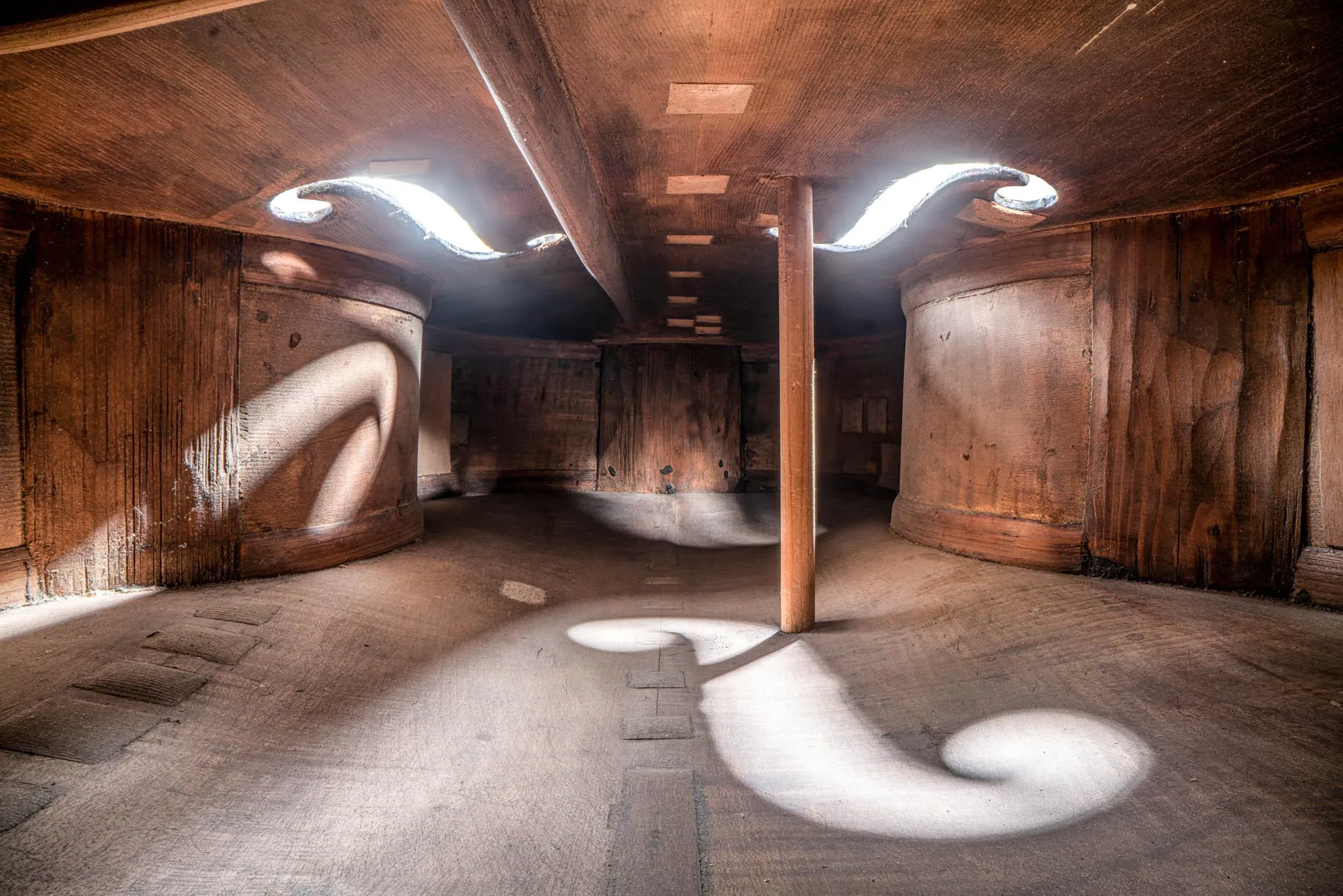
This is what Charles Brooks wrote about it:
Inside a 240 year old cello built by Lockey Hill circa 1780.
This is a reshoot of a photograph I made about 10 months ago.
When I first posted it people were commenting that it looked like the inside of a boat or barn, so I wanted to print it really large… However there was a lot of noise in the photo and a lack of detail in the dark areas. Big prints just didn’t look good. So I rephotographed it using different techniques.
The Instrument:
Lockey Hill was one of the earliest members of the Hill & Sons family. They would go on to become the most famous family of luthiers in the UK, kind of like the Stradivari family of Italy (although not that famous…). Lockey’s career was cut short when he was executed for horse theft in 1790! For those wanting to read the grizzly details you can see his trial notes here:
Lockey said just a couple of short sentences in his defence,* apologising for character witnesses who never turned up:
Prisoner’s defence. - My Lord, I have no counsel to aid and assist me; I hope I shall have one in you: I am a musical instrument maker; Mr. Thompson, in St. Paul’s church-yard, and Mr. Longman, of Cheapside, were here yesterday, to give me a character, but they are in a great way of business, and they could not wait.
Q. (To Kirby.) What is the value of your gelding? - A. About 20l. or 22l.
GUILTY , Death . (Aged 44.)
Tried by the second Middlesex Jury, before Mr. RECORDER.
The Shoot:
I photographed this using two very specific pieces of equipment, a Lumix S1R camera and a Laowa 24mm probe lens. This combo let me slide the lens into the hole for the endpin at the base of the cello (we had to loosen the strings to do this), and then photograph it using “High-Res Mode” which employs pixel shifting to create 187 megapixel frames.
There are a couple of challenges with this technique. The first is that the lens itself doesn’t let a lot of light in (its aperture range is f/14-40), and the inside of the cello itself is really dark. So I have to use the lens at its widest aperture, which means I only have a few millimeters in focus at any one time.
I took around 120 images for this shot, each one focused slightly further away from the last. Each one of those was actually a combination of 8 frames put together in-camera! So there are at least 960 images making up this single photo!
I couldn’t use flash with the High-Res mode, so was stuck with continuous lighting. I used a couple of Apunture 600d lights which are extraordinarily bright, however they are very very hot! So I had to pause every 2 shots to let things cool down and not risk damage to the instrument. This took hours…
After that I needed to use special software (Helicon Focus) to combine the in-focus parts of each image and discard everything that was out of focus.
The result is a massive photo (16743 x 11143 pixels), which I can print in incredible detail up to at least 2 x 3 meters.
This whole technique creates a cool optical illusion, where the inside of the instrument appears much larger than reality. This is a combination of having everything in focus as well as having a wide angle lens which creates a lot of depth. It’s sort of the opposite of the tilt-shift effect where you selectively blur images typically shot from far away to make them look small.
TLDR: lots of photos together make small space look big.
Edit 1: I get it. None of you can afford apartments!
Edit 2: Thanks to those asking about prints. They’re available here along with other shots from the series: www.architectureinmusic.com/pages/gallery
How about that, eh?
Lockey Hill Cello Circa 1780 - Limited Edition Print – Architecture In Music
Visit www.architectureinmusic.com for other instruments shot with the same techniques.
Inside a ~140-year-old cello once hit by a train.
Inside a 2 million dollar violin
Inside Persephone (the guitar, not the goddess)
Inside a Muramatsu 14k gold flute
Didgeridoos aren’t carved - they’re eaten!
The craftsmanship of a Martin D35 guitar