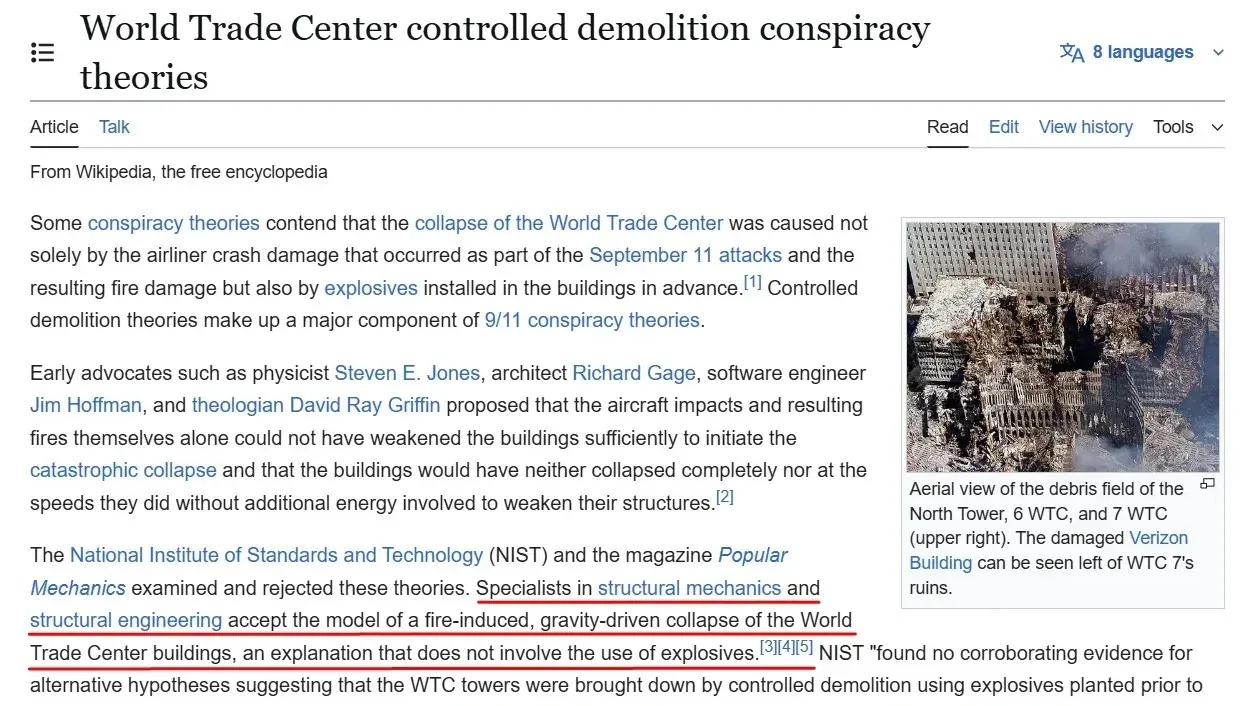
Wikipedia has a page titled World Trade Center controlled demolition conspiracy theories.
It starts off OK (apart from the “conspiracy theories” slur) with some bare facts:
Some conspiracy theories contend that the collapse of the World Trade Center was caused not solely by the airliner crash damage that occurred as part of the September 11 attacks and the resulting fire damage but also by explosives installed in the buildings in advance.[1] Controlled demolition theories make up a major component of 9/11 conspiracy theories.
Early advocates such as physicist Steven E. Jones, architect Richard Gage, software engineer Jim Hoffman, and theologian David Ray Griffin proposed that the aircraft impacts and resulting fires themselves alone could not have weakened the buildings sufficiently to initiate the catastrophic collapse and that the buildings would have neither collapsed completely nor at the speeds they did without additional energy involved to weaken their structures.[2]
True. True.
Then it says:
The National Institute of Standards and Technology (NIST) and the magazine Popular Mechanics examined and rejected these theories.
Well, yes, if you use a unique definition of “examined”. And see below for Paul Craig Roberts’s note about Popular Mechanics, but we’ll move on …
Then Wikipedia makes the following sweeping claim:
Specialists in structural mechanics and structural engineering accept the model of a fire-induced, gravity-driven collapse of the World Trade Center buildings, an explanation that does not involve the use of explosives.[3][4][5]
Well, that settles that then!
But I suppose we should follow the [3][4][5] links. They will presumably show, with true encyclopedic rigour and completeness, that “specialists accept …”.
Well, links [4] and [5] are both dead! But we have archived pages.
Link [4] - Professors of Paranoia? Academics give a scholarly stamp to 9/11 conspiracy theories | The Chronicle (🤣) - along with the academics giving a scholarly stamp to 9/11 conspiracy theories (thanks Wikipedia!), cites Zdenĕk Bažant (more later) and shifty Sivaraj Shyam-Sunder (NIST’s lead WTC investigator), who are the official story, but then does actually have someone credentialed saying
“There’s not really disagreement as to what happened for 99 percent of the details”
which, vague and lacking any proof, is as close as Wikipedia gets to providing evidence that NIST’s explanation is universally accepted. And even that assertion is clearly not true - which is provable by looking no further than the very next paragraph in the article Wikipedia cites and using an advocate the official account: Thomas W. Eager. He wrote a report cited by Popular Mechanics that in fact “doesn’t promote NIST’s theory of collapse at all”.
Link [5] - Conspiracies continue to abound surrounding 9/11: on the eve of the fifth anniversary, a group of professors say the attacks were an “inside job.” | Diverse Issues in Higher Education | BNET (🤣) - along with the professors saying the attacks were an “inside job” (thanks Wikipedia!), has precisely one person supporting the official theory, and he’s “a member of the World Trade Center Building Performance Study”.
That leaves us with link [3]. This is the Bažant paper (pdf) from 2006. It contains a lot of stuff like this:
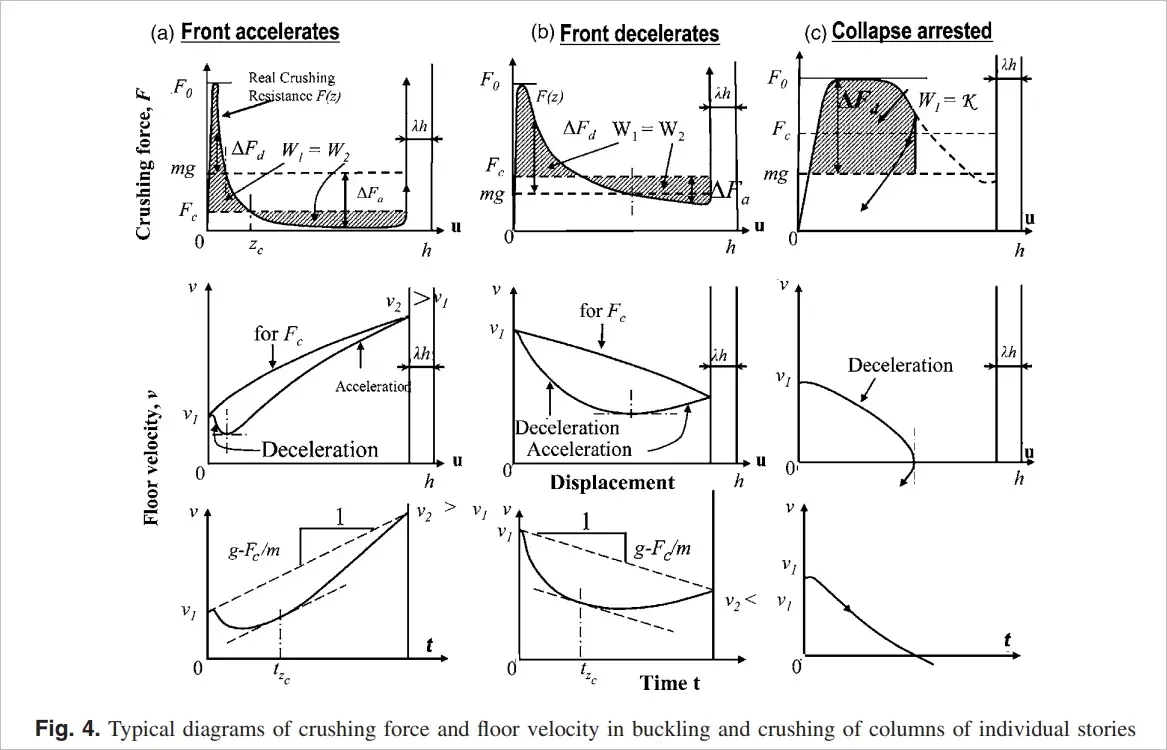
and this:
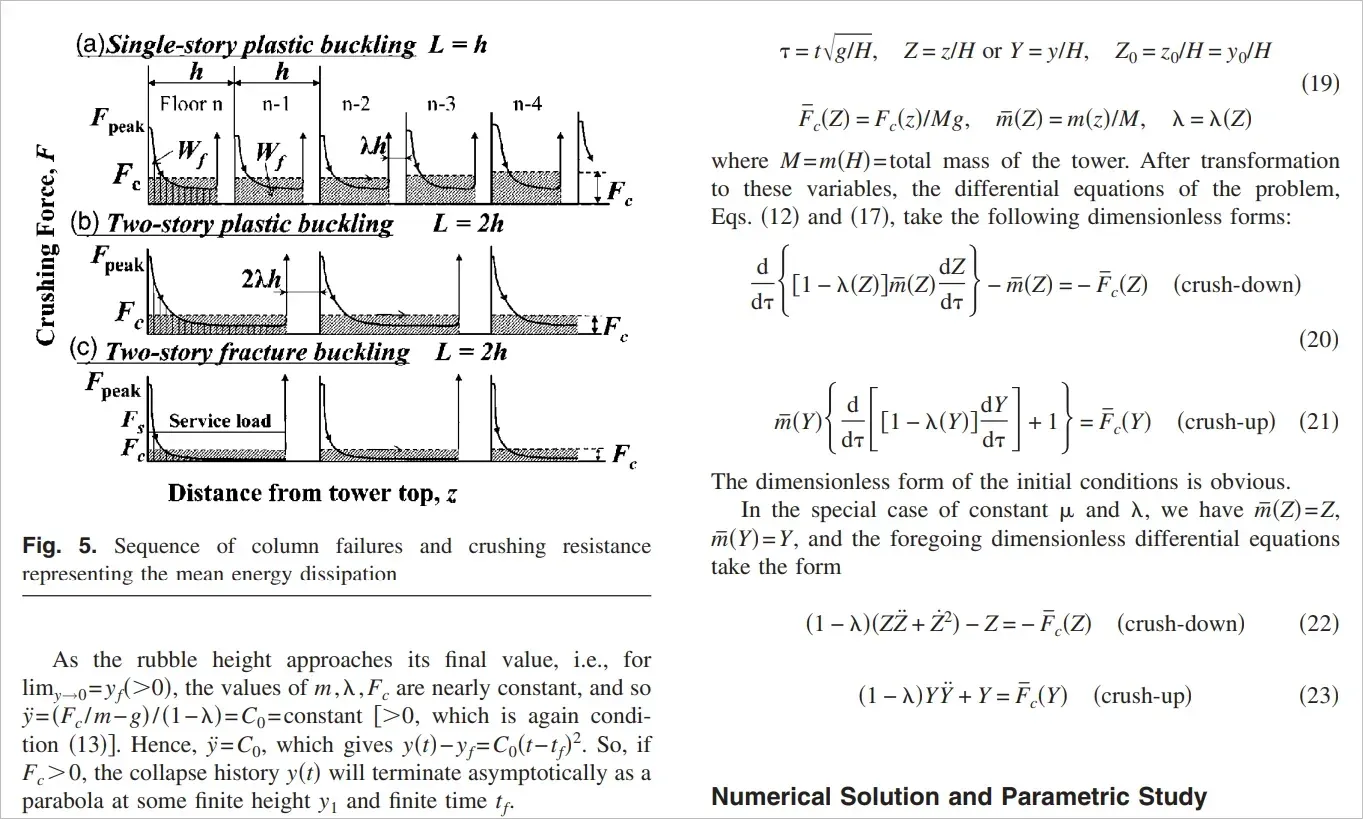
and then, just to make the case crystal clear, finishes with:
Have you got that, you conspiracy nutjobs?
I hope so.
With one link, Wikipedia casts aside all doubts about the official explanation.
Perish the thought that Bažant is trying to blind you with science.
I trust you will heed Wikipedia’s clearly watertight assertions and continue to ignore what your eyes see:
Appendix 1: A full rebuttal of the Bažant Theory
The Missing Jolt:
A Simple Refutation of the NIST-Bazant Collapse Hypothesis
Graeme MacQueen
Tony SzambotiApril 22, 2009
In its Final Report on the Collapse of the World Trade Center Towers, the National Institute of Standards and Technology summarizes its three year study and outlines its explanation of the total collapse of WTC 1 and WTC 2. [1]
Readers of the report will find that the roughly $20 million expended on this effort have resulted in an explanation of the total collapse of these buildings that is so vague it barely qualifies as a hypothesis. But it does have one crucial feature of a hypothesis: it is, in principle, falsifiable. In fact, it is easy to demonstrate that it is false.
In this paper we will, concentrating on the North Tower, offer a refutation that is:
- easy to understand but reasonably precise
- capable of being stated briefly
- verifiable by any reader with average computer skills and a grasp of simple mathematics.
…
See also
In this July 2023 edition of The Focus, mechanical engineer, Tony Szamboti gives us a crash course on his missing jolt research, which refutes the theory offered by Northwestern University engineering professor, Zdeněk Bažant of how the Twin Towers came down and which was incorporated by NIST into its official reports.
Szamboti tells the story of how the Journal of Engineering Mechanics dishonestly refused to publish his paper that challenges Bažant’s theory by claiming that it’s “out of scope” for the journal.
Joining him are engineers, Roland Angle, Kamal Obeid, Eugene Johnson, and John Schuler who offer their own commentary on the research presented and the controversy surrounding it.
Appendix 2: Paul Craig Roberts on Popular Mechanics
Along with the dodgy Bažant paper, the Popular Mechanics article is the most cited source supporting the official ‘explanation’. But look what happened there before 9/11 …
Perhaps it is merely a coincidence that just prior to 9/11 Cathleen P. Black, who has family connections to the CIA and Pentagon and is president of Hearst Magazines, the owner of Popular Mechanics, fired the magazine’s editor-in-chief and several senior veteran staff members and installed James B. Meigs and Benjamin Chertoff, a cousin of Bush administration factotum Michael Chertoff. It was Meigs and Benjamin Chertoff who produced the Popular Mechanics report that Griffin has eviscerated.
Paul Craig Roberts
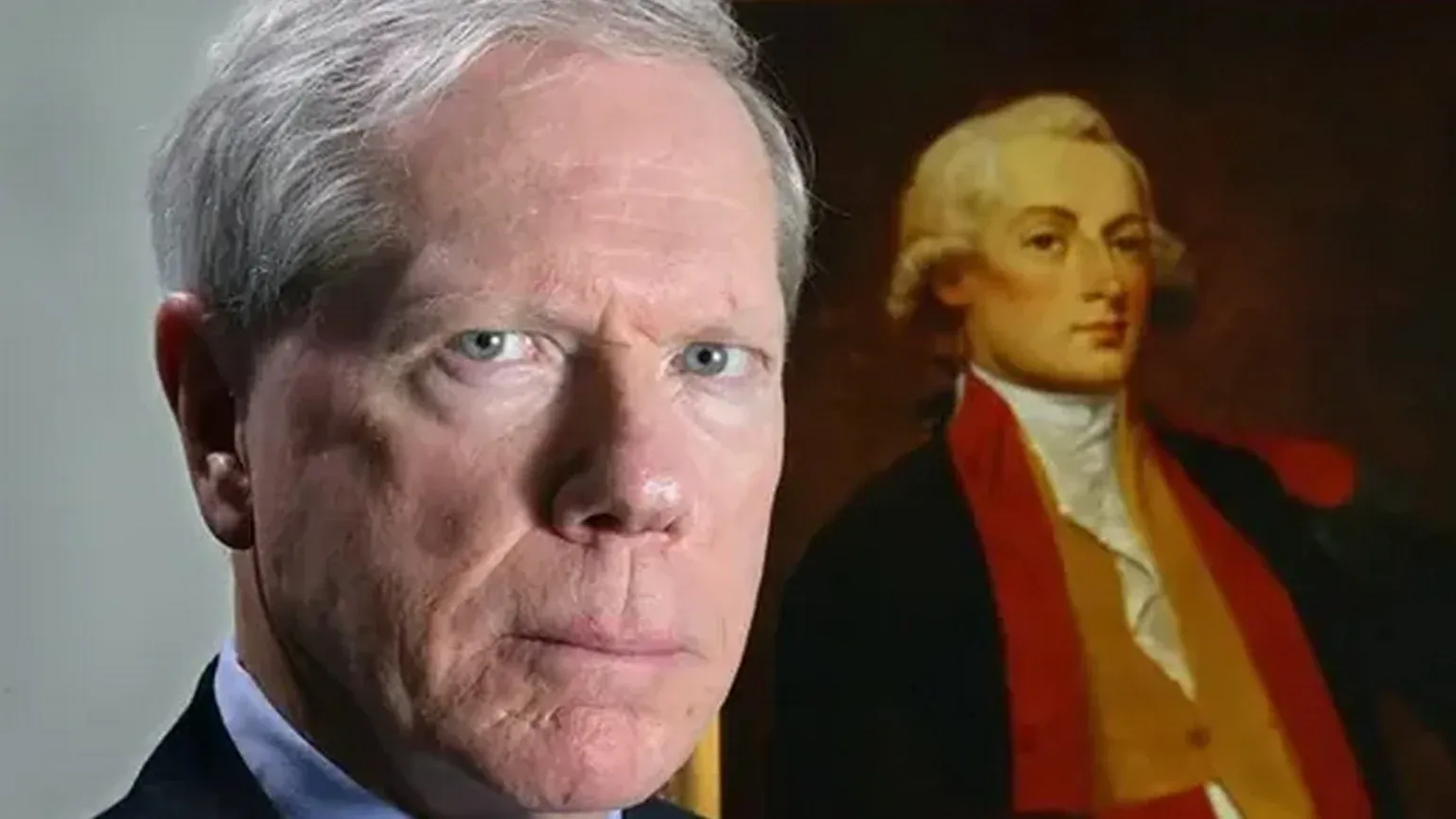
Analyst and adviser at the United States Congress where he was credited as the primary author of the original draft of the Economic Recovery Tax Act of 1981. United States Assistant Secretary of the Treasury for Economic Policy under President Ronald Reagan.
Later held the William E. Simon chair in economics at the Center for Strategic and International Studies for ten years and served on several corporate boards. Senior Research Fellow at the Hoover Institution, Stanford University.
Former associate editor at The Wall Street Journal. His articles have also appeared in The New York Times and Harper’s. Author of more than a dozen books and a number of peer-reviewed papers.
1981 — United States Treasury Meritorious Service Award. 1987 — French Legion of Honour (chevalier). 2015 — International Journalism Award for Political Analysis. 2017 — Marquis Who’s Who Lifetime Achievement Award.
I find the facts against the official story of the buildings’ collapse more compelling than the case that has been made in behalf of the official story. I would like to see the issue debated by independent scientists and engineers, if such people exist.
Over the past six years, the ranks of distinguished skeptics of the 9-11 storyline have grown enormously.
The ranks include distinguished scientists, engineers and architects, intelligence officers, air traffic controllers, military officers and generals, including the former commanding general of U.S. Army Intelligence and Security Command, former presidential appointees and members of the White House staff in Republican administrations, Top Gun fighter pilots and career airline pilots who say that the flying attributed to the 9-11 hijackers is beyond the skills of America’s best pilots, and foreign dignitaries.
When faced with disturbing events, the Romans asked a question, “Cui bono?”; Who benefits? This question was conspicuously absent from the official investigation.
Who are the beneficiaries of 9-11? The answer is: the military-security complex, which has accumulated tens of billions of dollars in profits; U.S. oil companies, which hope to get their hands on Iraqi and perhaps Iranian oil; the Republican Party, which saved a vulnerable newly elected president, George W. Bush, viewed by many as illegitimately elected by one vote of the Supreme Court, by wrapping him in the flag as “war president”; the Republican Federalist Society, which used 9-11 to achieve its goal of concentrating power in the executive; Vice President Dick Cheney and the neoconservatives, who used the “new Pearl Harbor” to implement their “Project for a New American Century” and extend American hegemony over the Middle East; and right-wing Israeli Zionists, who have successfully used American blood and treasure to eliminate obstacles to Israeli territorial expansion.